


Total Cost of Ownership: Why a Quality Duct Rodder Costs Less Than a Cheap One
Author:jiujiu Release time:2026-11-10 17:29:29 Number of views:123order
A rodder is a low-value item that controls a high-value process. When it fails, the cost is not the tool: it is a crew standing idle, a second mobilisation, and in the worst case cable stranded in a duct that has to be recovered. Comparing quotations on unit price therefore measures the wrong number. The meaningful comparison for a fiberglass duct rodder is total cost of ownership across its working life.
The Five Cost Components
| Component | What It Includes | Why Price-Only Buying Misses It |
|---|---|---|
| Acquisition | Rod, frame, heads, spares, freight and duty | The only figure that appears on an invoice comparison |
| Failure cost | Replacement rods, shortened sections, new heads | A cheap rod can be replaced several times over one quality rod's life |
| Labour cost | Time lost to stalls, re-rodding, re-mobilisation | One stalled pull costs more than the price difference between rod grades |
| Cable damage | Spoiled cable, re-pull, commissioning failure | The largest single risk and the least visible at purchase |
| Administrative cost | Re-ordering, warranty claims, supplier churn | Recurring overhead that never appears in a unit price |
Where Quality Changes the Total
1. Cycle life
A rod tested to 12,500 bending cycles and a rod with no published cycle rating may look identical. Over a season of daily coiling and feeding, the gap appears as replacement frequency. Buyers who record replacement dates almost always find that the cheapest rods are the most frequently purchased.
2. Diameter tolerance
Consistent diameter — typically around ±0.10 mm — means predictable stiffness and clean feeding. Variable diameter produces binding at fittings, which produces forcing, which produces failures.
3. Jacket durability
The jacket is the wear surface. A hard, smooth, abrasion-resistant coating survives contact with conduit edges; a thin one exposes fibre, and exposed fibre ends the rod's life and its insulating advantage.
4. Frame and brake
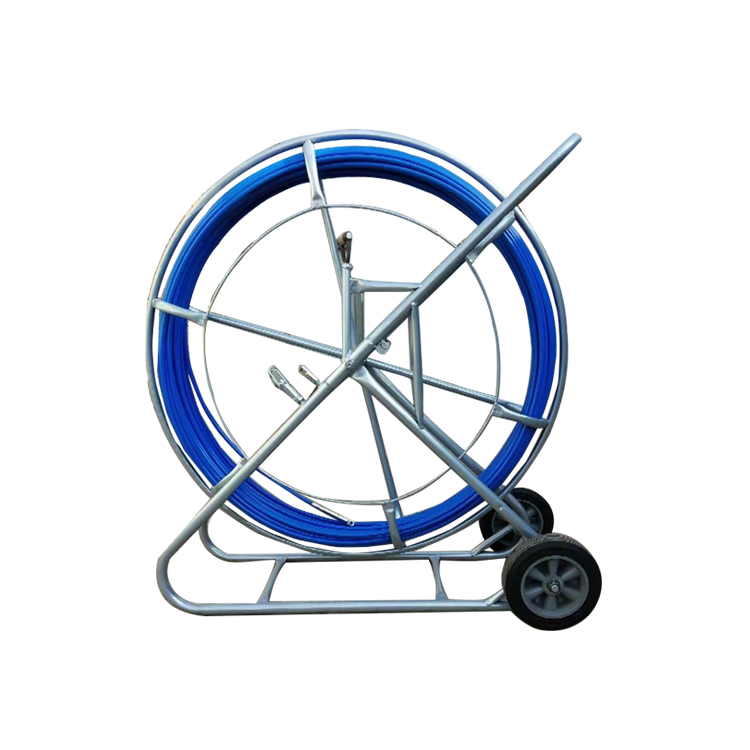
A braked steel frame with guide rollers protects the rod at the highest-wear point and prevents the overrun that damages rods during pay-out. Light frames without brakes are a common hidden cost on rods above 11 mm.
5. Temperature verification
Verified performance from -40 °C to +60 °C removes seasonal failure from the model. Rods without a stated range fail unpredictably, which is the most expensive kind of failure.
A Simple Ownership Comparison
Consider a crew rodding roughly 200 conduit runs per year:
Quality rod: purchased once, minor head and eye replacements, no lost pulls attributable to the tool.
Cheap rod: purchased two to three times over the same period, plus the stalls, re-rods and re-mobilisations that accompany each degradation phase.
Even before cable damage is counted, the cheaper option usually costs more by the end of the first year. Add one damaged cable length and the comparison stops being close.
Practical method: record the purchase date on every rod and frame. Twelve months later you will have real replacement data for your own working conditions — more persuasive than any supplier claim.
Specification Decisions That Reduce Total Cost
Size the diameter to the longest run, not the average. An undersized rod buckles, stalls and gets forced.
Buy length once. A rod 20 m short means an intermediate pit, which costs more than the extra length.
Specify the frame with the rod. Brake, guide rollers and wheels are not optional above 11 mm.
Stock heads and eyes. Replacing a £5 head the same day prevents a damaged rod next week.
Choose traceable variants where routes are undocumented. One unnecessary exploratory excavation exceeds the upgrade cost.
Consolidate the toolkit. Rodder, reel stand, pulleys and fish tape from one source removes compatibility gaps and consolidates freight.
What to Ask a Supplier Before Comparing Prices
Is cycle testing performed per batch or on samples only?
What is the stated diameter tolerance and how is it measured?
Is the temperature range tested or estimated?
Are spare eyes, heads, brake parts and bearings stocked?
What is the frame material and finish, and does it include a brake?
Is the jacket material specified, and is a cut-end sample available?
A supplier who answers these questions in writing is usually a supplier whose product will not need replacing next season.
When the Cheapest Option Is Correct
There is a legitimate place for a basic rod: occasional use, short indoor runs, low bend counts, and a user who will inspect and maintain it. The error is not buying inexpensive tools; it is buying inexpensive tools for demanding work and then attributing the resulting failures to bad luck.
Compare rodders on total cost
Send us your annual run count, typical run length and conduit sizes. We will specify a rod diameter, length, frame and spares package, with published cycle-life and temperature figures, so you can compare on ownership cost rather than invoice price.