


Traceable Fiberglass Duct Rodder: Precision Underground Conduit Locating for Cable Installation
Author:jiujiu Release time:2026-10-05 10:05:16 Number of views:121order
Locating an unmarked duct is rarely about owning more equipment — it is about avoiding the cost of digging in the wrong place. For municipal crews and telecom contractors working on legacy networks, a traceable duct rodder turns an unknown underground path into a mapped, verified route before a single metre of cable is pulled. The added copper conductor inside the rod costs little relative to a day of exploratory excavation, and it converts a standard fiberglass duct rodder into a dual-purpose locating instrument.
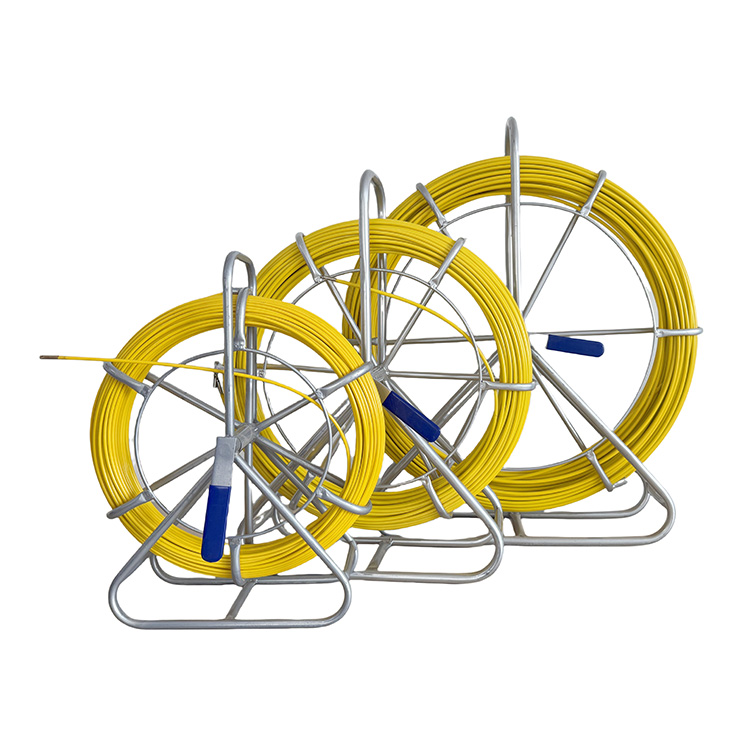
Why Conventional Rodding Leaves Crews Guessing
Underground conduit installed ten or twenty years ago often exists only in paper records that no longer match the ground. When a telecom operator plans a fibre drop or a municipality adds street-lighting circuits, the first question on site is always the same: where exactly does this duct run? A standard rod will pass through the conduit, but it cannot tell the crew where the rod is at any given moment. The result is trial excavation, traffic management extensions, and permit delays that routinely cost more than the cable installation itself.
The practical consequence is risk transfer. Without a verified path, the crew either opens more trench than necessary or pulls cable through a route whose depth and clearance are unknown — a condition that leads to later damage during third-party works.
How a Traceable Duct Rodder Works
A traceable rod is manufactured using the same pultrusion process as a standard FRP rod: continuous E-glass fibre is drawn through a resin bath and cured at high temperature to produce a rod with a high strength-to-weight ratio and full electrical non-conductivity on its outer surface. The difference is a copper conductor embedded along the rod's axis, terminated at the pulling eye and at the reel-end connector.
Signal injection. A portable transmitter is clipped to the rod's terminal end, applying a tone to the internal copper conductor.
Propagation. The tone travels the full length of the conductor and radiates a detectable electromagnetic field along the rod's path — including through soil, asphalt and concrete.
Surface detection. A handheld receiver carried over the surface picks up the field, letting the operator walk the route and spray-mark the conduit alignment and estimate depth.
Rodding completion. Once the path is mapped, the same rod continues its normal duty: pushing a pilot line, a draw rope, or pulling the cable itself.
Because the copper core sits inside the rod, the outer jacket remains non-conductive. Operators working near energised equipment keep the electrical-insulation advantage that makes FRP duct rodder tools the default choice over steel in utility environments.
When Specifying a Traceable Rod Makes Commercial Sense
Not every job justifies the upgrade. The following conditions are the ones where project managers consistently recover the cost difference on the first deployment:
Legacy municipal duct networks where as-built drawings are missing or unreliable.
Congested utility corridors carrying power, gas, water and comms in close proximity, where strike risk is high.
Long runs exceeding 200 m with intermediate access points that must be located from the surface before excavation.
Pre-installation duct surveys performed as a billable service before a fibre build.
Duct cleaning and inspection contracts where the crew needs to prove the cleaned section to the client.
Specifications to Verify Before Ordering
| Parameter | Typical Range | Why It Matters on Site |
|---|---|---|
| Rod diameter | 6 mm – 16 mm | Larger diameters deliver higher pushing force over long runs; smaller diameters handle tighter bends. |
| Rod length | 50 m – 500 m | Should exceed the longest expected run by 15–20% to avoid splicing mid-job. |
| Conductor continuity | Full-length copper core | A broken or partial conductor creates blind spots that defeat the purpose of tracing. |
| Bending cycle rating | ≥ 10,000 cycles (typical production test 12,500) | Confirms the rod survives repeated coil-and-feed stress without fatigue failure. |
| Service temperature | -40 °C to +60 °C | Guarantees performance in winter trench work and hot-climate surface storage. |
| Jacket | Abrasion-resistant polymer coating | Protects the rod from moisture, soil chemistry and conduit-edge wear. |
| Metre marking | Laser-etched or printed, optional | Lets the crew read depth-in-duct directly and log obstruction locations. |
Field tip: Always perform a continuity check with the transmitter before the rod enters the duct. A rod that has suffered internal conductor damage from an earlier kink will trace intermittently — the most common cause of a "lost signal" call is tool condition, not receiver failure.
Field Workflow: From Unknown Duct to Pulled Cable
Verify continuity — connect the transmitter, confirm tone at the far end.
Rod the conduit — feed steadily from the reel, using the brake to control payout and avoid rod buckling.
Trace and mark — walk the surface with the receiver, marking alignment, depth estimates and any signal anomalies that indicate a collapsed section.
Clear the path — fit a duct brush or cleaning head and pull it back through the run to remove silt and debris.
Install the draw rope or cable — attach to the pulling eye with a swivel, apply pulling lubricant, and draw the cable back with a controlled, monitored tension.
Used this way, one tool performs survey, cleaning and installation. For contractors who bill survey separately, that is three chargeable operations from one piece of equipment.
Choosing a Manufacturing Partner
The tracing function is only as reliable as the rod's construction. Buyers should ask the manufacturer for the pultrusion resin system, the conductor specification, and evidence of routine mechanical testing. Frame details are equally practical: a powder-coated or hot-dip galvanised steel frame, a parking brake, guide rollers at the feed mouth and rubber wheels all reduce operator fatigue on long pushes.
Reputable factories also support OEM requirements — custom rod colours, printed length scales, branded reel frames and export cartons — which matters for distributors building their own product line rather than reselling a generic catalogue item.
Need a traceable rodder sized for your network?
Cangzhou Jiujiu Communication Equipment Co., Ltd. manufactures traceable and standard fiberglass duct rodders from 4.5 mm to 16 mm and 10 m to 500 m, with copper-core tracing, custom metre marks and OEM branding. Every unit is bending-cycle and temperature tested before shipment.
Request a Specification & Quote