


Large-Diameter Fiberglass Duct Rodder: Engineering Pushing Force for Long-Distance Fiber Optic Pulls
Author:jiujiu Release time:2026-10-08 10:24:23 Number of views:99order
Every long conduit run fails the same way — the rod stops advancing and buckles somewhere out of sight. That failure point is a function of rod diameter, not operator effort. For backbone fibre, municipal duct and utility crossings exceeding 200 metres, a large diameter duct rodder in the 11 mm to 16 mm class is the specification that separates a completed pull from a recovered rod and a re-mobilised crew.
The Physics That Decides Your Rod Size
When a rod is pushed into a conduit, the compressive load travels along its length. Slender rods carry that load poorly: beyond a critical distance the rod deflects sideways, contacts the duct wall, and the pushing force is consumed by friction instead of forward travel. Increasing diameter raises the rod's second moment of area dramatically, so a 14 mm rod resists buckling roughly four to six times better than a 9 mm rod of identical material.
Diameter also governs two other variables project engineers care about: the maximum tensile load available during the pull-back phase, and the rod's ability to survive being dragged over conduit edges and joint offsets without permanent deformation.
Matching Diameter to Run Length
| Rod Diameter | Practical Run Length | Typical Application | Handling Note |
|---|---|---|---|
| 4.5 mm – 6 mm | Up to 80 m | Indoor risers, residential wiring, tight multi-bend conduit | One-person operation; very high bend tolerance |
| 8 mm – 10 mm | 80 m – 150 m | Campus networks, commercial buildings, mixed indoor/outdoor | Balanced flexibility and push force |
| 11 mm – 12 mm | 150 m – 250 m | FTTH distribution, urban duct sections | Standard reel frame; two-person feed recommended |
| 13 mm – 14 mm | 250 m – 350 m | Backbone fibre, municipal duct, road crossings | Heavy-duty frame with brake required |
| 16 mm and above | 350 m – 500 m | Utility transmission duct, long industrial runs | Wheeled frame or trailer; plan intermediate access |
What a Large-Diameter Rod Actually Delivers on Site
Specifying up-front costs more than a small rodder, but the return appears in three measurable places:
Fewer intermediate access pits. A 14 mm rod completing 300 m removes the need to open and reinstate a mid-run joint — often the single largest cost item in an urban build.
Lower cable damage risk. Higher, steadier pulling tension with fewer stops means less chance of exceeding the cable's maximum rated pull force and less jacket scuffing at bends.
Longer service life. Larger rods operate further from their fatigue limit. Where a 6 mm rod may need replacement after a season of daily use, an 11 mm or 14 mm rod on the same work typically runs for years.
Specifying rule of thumb: for optical cable runs beyond 200 m, specify 14 mm or larger. Below 100 m of indoor work, a 10 mm–12 mm rodder keeps the flexibility needed for multiple bends while avoiding the weight penalty of a heavy rod.
Reading the Specification Sheet Correctly
Two numbers are routinely misread by buyers comparing quotations:
Tensile strength versus bending force
Tensile strength describes what the rod survives while pulling cable back — important, but rarely the limiting factor. Bending force (the load the rod takes before permanent set) is what determines whether it survives being coiled and forced around a bend on a daily basis. Ask for both.
Temperature range
A rod rated from -40 °C to +60 °C will not become brittle during winter trench work or soften when stored on a hot truck bed. Low-cost rods with an unspecified range are the ones that snap unexpectedly in cold weather.
Cycle testing
Quality manufacturers publish a bending-cycle figure. A production test of 12,500 cycles without structural failure is a meaningful benchmark and a quick way to separate engineering-grade product from commodity imports.
Frame and Reel: The Half of the Tool Buyers Forget
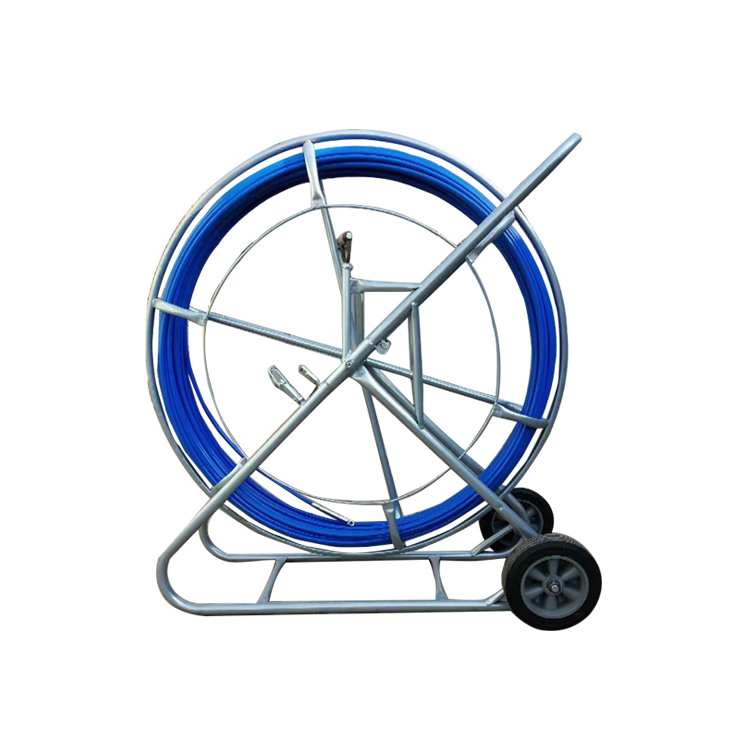
A 16 mm, 300 m rod weighs far more than the reel it arrives on. The frame specification matters as much as the rod:
Powder-coated or hot-dip galvanised steel frame for corrosion resistance in wet trench conditions.
Parking brake to arrest reel rotation when the rod hits an obstruction — uncontrolled reel spin is a common cause of rod splintering.
Guide rollers at the feed mouth to protect the jacket at the highest-wear point on the tool.
Rubber wheels and a tilting handle so two-person transport across a site does not become a lifting hazard.
Feed device allowing the rod to be paid out or wound back with a simple push or pull.
Pulling Technique for Long Runs
Clean and prove the duct first — brush or pig the run, then rod it.
Use pulling lubricant compatible with the cable jacket; on long runs this reduces required tension by a substantial margin.
Place cable pulleys at every bend and access point to convert sliding friction into rolling contact.
Pay cable off a cable reel stand with a brake instead of pulling directly from a static drum.
Insert a breakaway swivel between rod and cable, and monitor tension continuously.
Executed in that order, a large-diameter rod turns a marginal 300 m pull into a routine one.
Specify the right rod the first time
We manufacture large-diameter fiberglass duct rodders from 11 mm to 16 mm and 100 m to 500 m, with pultruded FRP core, abrasion-resistant jacket, braked steel reel frames, metre marking and OEM branding. Tell us your run length and conduit profile — we will size the rod, the reel and the pulling accessories as one package.
Get a Sized Recommendation