


Heavy-Duty Cable Pulley: Controlling Pulling Tension on Long Conduit Runs
Author:jiujiu Release time:2026-10-17 15:43:11 Number of views:123order
Most cable damage on site is not caused by the pull itself but by what the cable is dragged across. Every bend, junction and access point converts pulling force into sidewall pressure and abrasion, and tension accumulates along the run. A cable pulley placed at those points replaces sliding friction with rolling support — the cheapest and most effective tension-control measure available to an installation crew.
Where Tension Comes From
Pulling tension has three sources: the weight of the cable itself, friction against the conduit wall, and the multiplier effect of every bend. The bend multiplier is the aggressive one — each change of direction increases the effective tension required downstream of it, which is why a run with six bends can demand several times the pull force of a straight run of equal length. Exceed the cable manufacturer's maximum pulling tension and the consequence is conductor stretch, jacket deformation or, on fibre, micro-bending loss that only shows up at commissioning.
What a Pulley Changes
A pulley supports the cable on a rotating wheel rather than letting it bear against a fixed surface. Three practical effects follow:
Friction conversion. Sliding contact becomes rolling contact, cutting the friction component at that point substantially.
Bend radius control. The wheel's groove holds the cable on a defined radius, preventing the flattening that occurs when cable is pulled hard around an edge.
Jacket protection. The cable never touches the conduit lip, manhole wall or tray edge — the surfaces that cause most visible installation damage.
Field reality: on runs longer than roughly 150 m, or with more than three direction changes, pulleys plus pulling lubricant are usually the difference between a pull that completes and one that stalls halfway with cable already committed to the duct.
Specifying the Right Pulley
| Specification | Why It Matters | Selection Guidance |
|---|---|---|
| Wheel diameter | Sets the minimum bend radius the cable experiences | Larger diameter for power cable and stiff conductors; smaller for data and fibre |
| Groove size | Must seat the cable without pinching | Groove width should exceed cable OD; oversized grooves allow the cable to ride out |
| SWL rating | Safe working load under sidewall pressure | Select above the maximum anticipated tension, not the average |
| Mounting type | Determines where it can be installed | Manhole frames, conduit mouths, tray edges and corner assemblies each need their own mount |
| Bearing quality | Sealed bearings keep working after exposure to grit and water | Sealed or greasable bearings for outdoor and underground duty |
| Frame finish | Corrosion resistance in wet environments | Galvanised or powder-coated steel for permanent or semi-permanent installations |
Standard pulley or heavy pulley?
The distinction is load and duty cycle. Standard pulleys suit light data cable, short pulls and occasional use. A heavy pulley — larger wheel, higher SWL, reinforced frame and sealed bearings — is the correct specification for power cable, long runs, repeated daily use and any situation where a failure mid-pull would strand cable in the duct.
Placement: The Part Crews Get Wrong
At the pay-off point, immediately after the cable reel stand, so cable leaves the drum in line.
At every bend in the conduit route, with the wheel tangent to the change of direction.
At every access pit and junction, even where the route appears straight — this is where cable otherwise rubs on the pit edge.
At mid-run intervals on long straight sections, spaced to keep the cable off the duct invert.
At the pulling end, before the winch or pulling grip, to align the final approach.
Anchor each pulley against the direction of pull. A pulley that shifts under load stops rotating, and a non-rotating pulley is simply an obstruction.
A Complete Low-Tension Pulling Set-Up
Pulleys are most effective as part of a system. The working sequence used by experienced telecom and utility crews:
Brush or pig the duct, then rod it with a fiberglass duct rodder to prove the path.
Apply pulling lubricant compatible with the cable jacket.
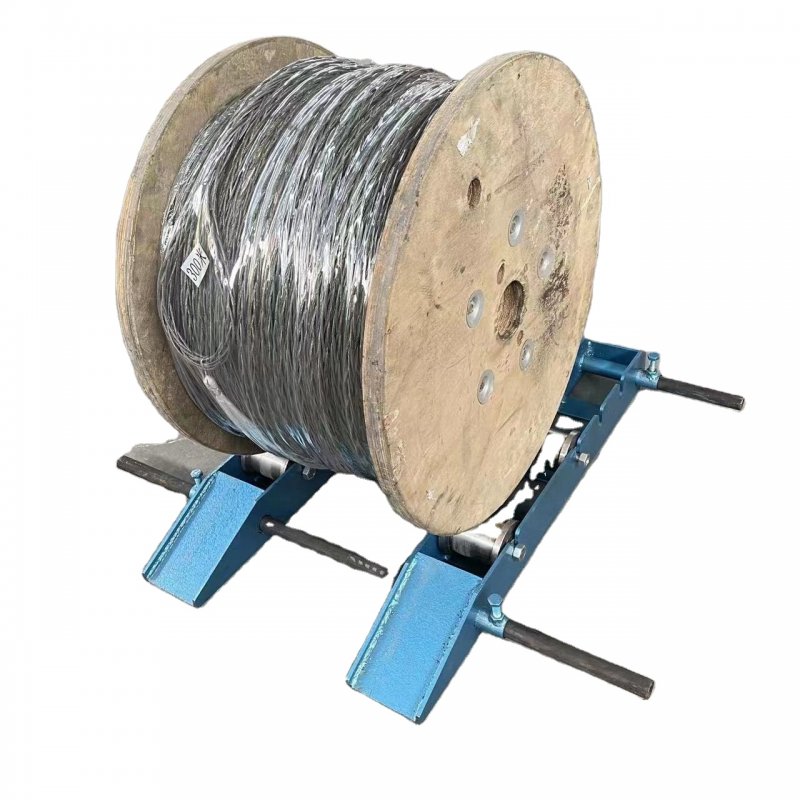
Mount the drum on a cable reel stand with a brake, aligned with the first pulley.
Place pulleys at all bends, junctions and mid-run points.
Connect rod to cable with a breakaway swivel, and monitor tension throughout.
Pull at steady speed; stop immediately if tension spikes and investigate rather than pulling harder.
Inspection and Care
Pulleys are inexpensive but frequently neglected. Before each job, spin every wheel by hand and listen: roughness indicates bearing contamination. Check groove surfaces for burrs or cracks, confirm frame bolts are tight, and wash off mud and cable lubricant after use so grit does not enter the bearings. A pulley set maintained this way will outlast several seasons of daily work.
Build a low-tension pulling package
We manufacture cable pulleys and heavy pulleys with sealed bearings, galvanised frames and defined SWL ratings, and supply them alongside fiberglass duct rodders, fish tape and cable reel stands so your whole pulling set-up arrives in one shipment.
Request Pulley Specifications