


Steel Fish Tape vs Fiberglass Fish Tape: A Professional Selection Framework
Author:jiujiu Release time:2026-10-20 15:59:31 Number of views:89order
The choice between a steel fish tape and a fiberglass fish tape is not a matter of preference — it is a matter of what the conduit, the environment and the cable will tolerate. Steel delivers stiffness and raw pulling strength at short range; fiberglass delivers electrical safety and bend tolerance. Contractors who carry both, and know exactly when to reach for each, complete more pulls per day and damage less cable.
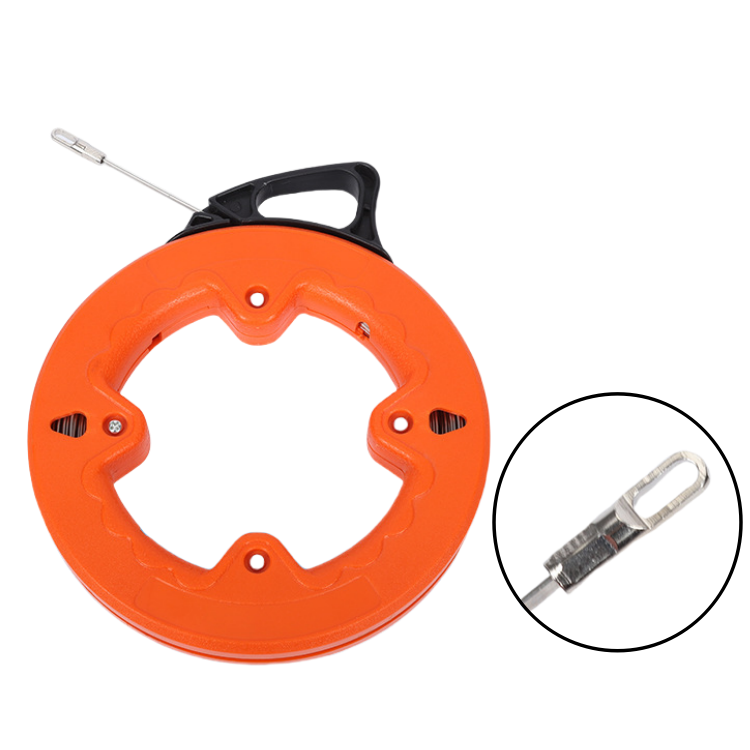
How the Two Materials Behave in Conduit
A fish tape is pushed, not pulled, through the first part of its journey, and that is where the materials diverge.
Steel has high column stiffness, so it pushes further before buckling. In a straight run with few bends, it will often reach the far end faster than any alternative.
Fiberglass stores and releases elastic energy, letting it snake around multiple bends and return to shape. Where a steel tape meets a tight bend it tends to bind, and where it kinks it is effectively finished.
Pull-back strength tells a similar story: steel handles very high tensile loads, while fiberglass — in tape or rod form — offers more than enough for data, communications and most building power work, with the added property of being non-conductive.
Head-to-Head Comparison
| Criterion | Steel Fish Tape | Fiberglass Fish Tape / Rodder |
|---|---|---|
| Pushing distance | Excellent in straight or gently curved runs | Excellent through multiple bends and offsets |
| Bend tolerance | Binds at tight bends; kinks permanently | Navigates bends and recovers to original shape |
| Electrical safety | Conductive — hazard near live circuits | Non-conductive — safe around energised equipment |
| Typical length | 15 m – 100 m | 10 m – 500 m in rodder form |
| Weight and handling | Heavier, especially at longer lengths | Lightweight; reel-mounted for transport |
| Corrosion | Rusts if coating is damaged or stored wet | Resists moisture, soil chemistry and most chemicals |
| Failure mode | Sudden kink or snap | Gradual jacket wear; visible before failure |
| Cost profile | Lower initial cost per metre | Higher initial cost, longer service life |
Safety note: in any environment where live cables or energised equipment may be present, non-conductive fiberglass is the correct specification. Steel tape near live conductors is a recognised hazard, not a theoretical one.
Decision Framework: Which Tool for Which Job
Is the run under 30 m and mostly straight? A steel fish tape is fast, cheap and stiff enough to push without buckling.
Does the route include three or more bends? Choose fiberglass — in tape form for short indoor work, in rodder form for anything longer.
Is there any chance of live conductors? Fiberglass only.
Is the run longer than 60 m? Move from tape to a fiberglass duct rodder on a reel frame; tape length becomes unmanageable before that point.
Is the conduit metallic or the environment wet? Fiberglass avoids both the conductivity issue and the corrosion issue.
Is budget the only constraint and the work short and dry? Steel tape remains a legitimate, professional choice.
Specifications Worth Checking
Steel fish tape
Material: high-carbon spring steel for tensile strength and kink resistance.
Profile: flat tape in widths around 3.0 mm – 4.5 mm and thickness from roughly 0.8 mm to 1.6 mm.
Length options: 15 m, 20 m, 30 m, 50 m, 100 m, or custom.
Housing: ABS or engineering polypropylene with a smooth pay-out and rewind action.
End type: fixed pulling eye or interchangeable heads; leader tips available.
Extras: laser-etched measurement marks for reading feed depth, and OEM logo printing for distributors.
Fiberglass fish tape and rodder
Core: pultruded E-glass with high-temperature resin for consistent fibre density.
Jacket: developed polymer coating, hard, smooth and wear-resistant.
Diameter: 4.5 mm to 16 mm; length: 10 m to 500 m.
Optional copper core for traceable locating of the installed path.
Metre marking printed or etched along the rod.
Form Factor: Tape, Beetle Shaped Housing, or Rodder
Housing design is not cosmetic. A beetle shaped fish tape housing sits flat on the floor and pays out without the operator fighting a rolling case, which matters on repetitive indoor work. Compact housings suit electrical maintenance vehicles. Reel-mounted rodders with frames, brakes and wheels suit outdoor and underground work where length, weight and controlled payout dominate. Selecting by form factor as well as material is what keeps crews from improvising.
Care and Service Life
Steel tape should be wiped dry after use, lightly oiled in humid climates and retired at the first kink — a kinked tape will snap under load. Fiberglass tape and rods should be inspected for jacket cuts and splintering, cleaned of grit and stored out of prolonged direct sunlight. Neither tool benefits from being forced: when a push meets resistance, withdraw, rotate and re-feed rather than adding force.
Equip crews with the right tape for each job
Cangzhou Jiujiu Communication Equipment Co., Ltd. supplies steel fish tape and beetle-shaped fish tape alongside fiberglass duct rodders, cable pullers, reel stands and pulleys — with OEM lengths, measurement marks, logo printing and export packaging available on request.
Request Fish Tape Options