


Fish Tape and Cable Puller: The 2026 Field Guide for Electrical and Telecom Contractors
Author:jiujiu Release time:2026-10-23 16:50:16 Number of views:73order
Few tools determine a crew's daily output as directly as the ones used to get a line from point A to point B. A well-chosen set of fish tape and cable puller equipment turns a two-hour pull into a twenty-minute one; a mismatched set produces stalled pulls, damaged cable and overtime. This guide maps the pulling-tool landscape and gives contractors a build-order for four common crew profiles.
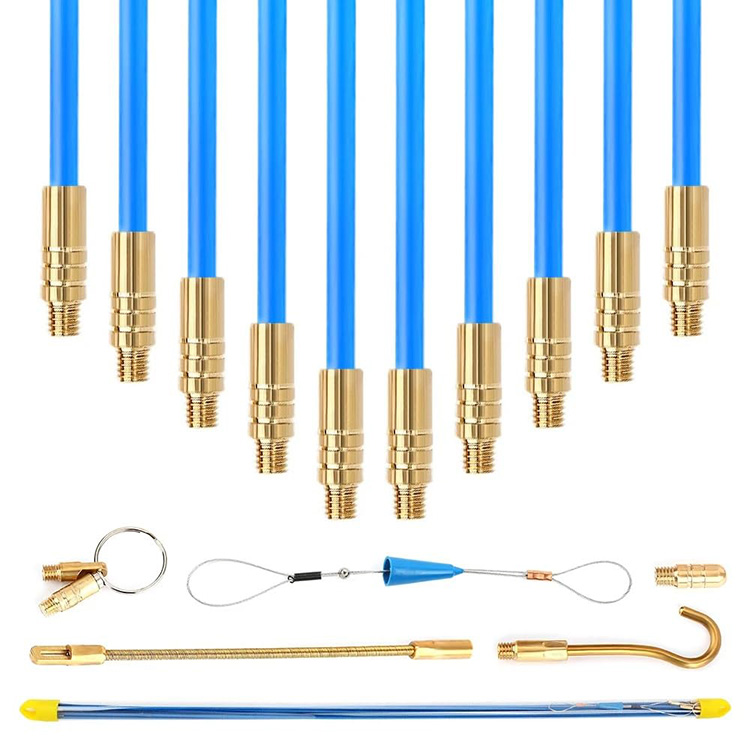
The Pulling Sequence, and the Tool for Each Stage
Every cable installation follows the same four stages. Matching a tool to each stage is what makes the work predictable:
Prove the path. A fiberglass duct rodder or fish tape is pushed through the conduit to confirm it is continuous and clear.
Clean it. A duct brush or pig pulled back through the run removes silt and construction debris.
Establish the pull line. A draw rope or the cable itself is attached to the rod's pulling eye, usually through a swivel.
Pull with control. A manual pull, a cable puller or a powered winch draws the cable back while tension is monitored and pulleys support the route.
Skipping stage two is the most common cause of a stalled pull. Skipping stage four's tension control is the most common cause of damaged cable.
Core Pulling Tools and Their Specifications
| Tool | Best Application | Key Specifications |
|---|---|---|
| Fiberglass duct rodder | Long duct runs, underground conduit, telecom and municipal work | Diameter 4.5–16 mm, length 10–500 m, tensile strength, reel frame with brake |
| Fiberglass fish tape | Indoor conduit, occupied buildings, live-circuit environments | Length 15–60 m, flat or round profile, non-conductive, tip type |
| Steel fish tape | Short, straight, dry runs where stiffness helps | Length 15–100 m, width 3.0–4.5 mm, thickness 0.8–1.6 mm |
| Manual cable puller | Controlled short-to-medium pulls, service work | Pull force rating, rope length, grip compatibility |
| Powered puller / winch | Heavy power cable, long industrial runs | Pull force 500–2000 kg, rope length, electric or hydraulic drive |
| Cable reel stand | Any drum-fed pull | Capacity 3T/5T/10T/15T, axle size, adjustable width, brake |
| Cable pulley | Bends, junctions, mid-run support | Wheel diameter, groove size, SWL rating, mounting type |
Support and Handling Equipment
The tools above get the cable moving; the following keep it undamaged:
Pulling grips and stockings — matched to cable type: weave-mesh Kellems grips for general use and fibre, cone grips for coaxial and single conductors, basket-weave for armoured industrial cable.
Swivels and snatch blocks — a breakaway swivel between rope and cable prevents torsional damage; snatch blocks allow insertion mid-run.
Pulling lubricant — essential on long runs; select a formula compatible with the cable jacket.
Tension meter — the only way to verify you are inside the cable manufacturer's limit.
Cable tray rollers — for tray installations where the cable should stay in the tray path.
Tension discipline: pull steadily and stop at any unexplained tension spike. Increasing pull force to overcome an obstruction is the fastest route to a written-off cable length.
Four Starter Kits by Crew Profile
Residential electrician
30 m fiberglass or steel fish tape, basic pulling grips, pulling lubricant, gloves.
Commercial contractor
100 m fiberglass duct rodder, cable reel stand (3T–5T), pulley set, lubricant, tension meter.
Telecom / fibre installer
200 m FRP duct rodder (traceable option), fibre-safe pulling grips, cable reel stand, duct brush set, OTDR.
Utility and municipal
300 m+ heavy-duty duct rodder, powered puller or winch, full pulley set, 10T–15T reel stand, duct camera.
Buying to a profile rather than to a single job avoids the familiar pattern of owning four short tapes and no rodder.
Selecting a Supplier for the Whole Set
Most contractors assemble these tools from several sources over years, which produces compatibility gaps — a grip that does not fit an eye, a stand whose axle does not suit the drum, a pulley rated below the pull force. Sourcing the rodder, fish tape, cable puller, reel stand and pulley from a single manufacturer removes those gaps and consolidates freight. When evaluating suppliers, ask for published mechanical test data, stated diameter and length tolerances, OEM options, and confirmation that spare ends, grips and bearings are stocked.
Frequently Asked Questions
What is the single most important cable installation tool?
The fiberglass duct rodder. It covers the widest range of applications — from building risers to 500 m municipal duct — and delivers the best return on investment for any professional crew.
When should a job move from manual pulling to a powered puller?
When the calculated pull approaches the cable's rated maximum, or when the run length and cable weight make steady, controlled pulling physically impractical. Long runs of large power cable are the clearest case.
How often should pulling lubricant be replaced?
Use fresh lubricant for each major job. Once opened, standard formulations keep for one to two years; discard product that has dried or become contaminated with debris.