


FRP Duct Rodder Specifications Explained: Diameter, Length, Tensile Strength and Cycle Life
Author:jiujiu Release time:2026-10-26 17:43:14 Number of views:89order
Two suppliers can quote the same "11 mm × 250 m duct rodder" and deliver products that behave completely differently on site. The difference lies in the numbers most buyers skim past: bending force, cycle rating, temperature range and diameter tolerance. Understanding FRP duct rodder specifications is the fastest way to compare quotations on engineering merit instead of on price.
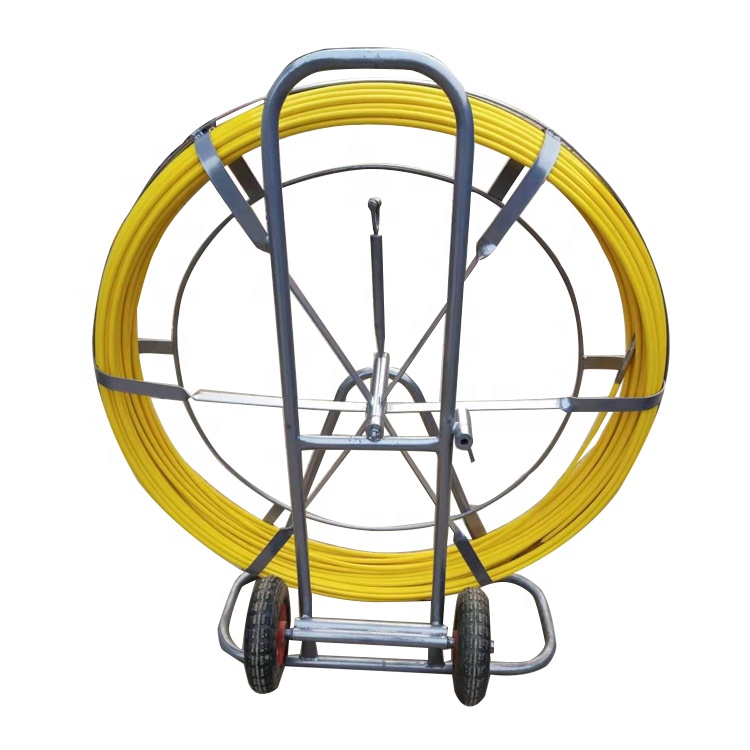
How a Duct Rod Is Made — and Why It Matters
Quality rods are produced by pultrusion: continuous E-glass fibre is pulled through a resin bath and cured at controlled high temperature. The process yields a rod with consistent fibre density along its entire length, which is what gives it both flexibility and structural rigidity. An outer jacket — a developed polymer coating that is hard, smooth and wear-resistant — is applied over the core to protect against moisture, abrasion and soil chemistry.
Where a supplier substitutes a lower fibre fill rate, a cheaper resin or a thin jacket, the rod still looks right and still ships. It simply buckles earlier, splinters sooner and fails in cold weather.
Diameter: The Specification That Governs Everything
Diameter drives buckling resistance, pulling stability and fatigue life. Available production sizes typically run 4.5, 6, 8, 9, 10, 11, 12, 13, 14, 15 and 16 mm, with larger sizes for heavy municipal duty. Popular stocked combinations include 4.5 mm × 50–70 m, 6 mm × 100 m, 8 mm × 150 m, 10 mm × 150 m, 11 mm × 250 m, 12 mm × 250 m, 14 mm × 250 m and 16 mm × 200 m.
| Diameter | Practical Reach | Why Crews Choose It |
|---|---|---|
| 4.5 mm – 6 mm | Up to ~80 m | Maximum flexibility in tight, multi-bend indoor conduit |
| 8 mm – 10 mm | 80 m – 150 m | Balanced flexibility and pushing force for general work |
| 11 mm – 12 mm | 150 m – 250 m | Standard choice for FTTH distribution and urban duct |
| 13 mm – 14 mm | 250 m – 350 m | Backbone fibre, municipal duct, road crossings |
| 16 mm + | 350 m – 500 m | Transmission duct and long industrial runs |
Length: Size for the Longest Run, Not the Average
Production length ranges from 10 m to 500 m, cut to order. Specify the longest run you expect plus a 15–20% margin. A rod that is 20 m short on a 300 m duct means opening an intermediate pit — the cost of which dwarfs the price difference between lengths.
Tensile Strength vs Bending Force
These two figures are frequently confused, and the distinction changes which rod you should buy:
Maximum tensile strength — the axial load the rod survives during the pull-back phase. Relevant, but rarely the limiting factor in normal work.
Maximum bending force — the load the rod takes before taking a permanent set. This governs everyday survival: coiling, feeding around bends, dragging over conduit edges.
Reading tip: published bending-force figures rise steeply with diameter — for example, values in the region of 0.2 kN at 4.5 mm, approaching 1.2 kN at 11 mm and roughly 2.9 kN at 16 mm. If a supplier quotes tensile strength but not bending force, ask for it.
Temperature Range and Cycle Life
A professional specification states a service range of -40 °C to +60 °C (some rod constructions are rated to +80 °C). This guarantees the rod will not become brittle during winter trench work or soften when stored on a hot vehicle or in direct sun.
Bending-cycle testing is the durability benchmark: quality rods are rated to exceed 10,000 cycles, and a production test regime of 12,500 cycles without structural failure or degradation is a strong indicator of a properly controlled pultrusion line. Ask whether the test is run per batch or reserved for samples.
The Numbers Buyers Overlook
Diameter tolerance — typically ±0.10 mm. Tighter tolerance means consistent feed through conduit and predictable stiffness.
Fibre density / fill rate — a higher glass content resin system delivers higher strength at the same diameter.
Jacket hardness and smoothness — determines abrasion life and how easily the rod slides past conduit offsets.
Pulling eye specification — rust-proof bull-nose eye with threaded accommodation for spring leaders, roller guides, brushes and cleaning heads.
Metre marking — laser-etched or printed scale for reading depth and logging obstructions; optional on most production runs.
Copper core option — provides traceability for locating the installed duct path.
Frame Specification: Half the Product
The rod's performance on site is limited by the frame it arrives on. Check for:
Powder-coated or hot-dip galvanised steel construction.
A working parking brake to arrest the reel when the rod meets resistance.
Guide rollers and a fixed ring at the feed mouth to protect the jacket.
Rubber wheels and a tilting handle for site transport.
A feed device allowing smooth pay-out and rewind.
A Specification Checklist You Can Send to Suppliers
Rod diameter and tolerance
Rod length and metre marking requirement
Maximum tensile strength and maximum bending force
Bending-cycle rating and whether it is batch-tested
Service temperature range
Jacket material and colour (yellow standard, others optional)
Copper-core traceable option: yes / no
Frame: material, brake, wheels, feed device
Pulling eye type and accessory heads required
OEM: logo, colour, packaging, carton print